
Scalable B2B Link Building: A Proven Framework for Growth
You can have a great team, dozens of quality B2B backlinks gained, and a strategy that works well. But once you try to scale your current approach, it still flops. Nothing seems to work anymore. How is this even possible?
This situation is much more common than you think, not only for small business owners. And the issue isn't that you don’t know how link building works. Not at all. The real problem is that you don’t have a repeatable framework that was built for scalability.
But we’ll change it in the next couple of minutes. After reading this guide, you’ll have a quality system that will help you scale link building easily.
Why B2B link building fails to scale
If you’re a small business asking this question, you’re way beyond the link building definition and other basic things. But still, even though you have experience, for some reason, scaling just doesn’t work.
Why is that?
You see, some strategies just weren’t meant to scale, whether it’s link building or anything else. Most likely, you’ve seen a similar situation at least once in your career: while the scale was small, everything seemed to work great. But once you expanded, it all crashed.
Why does this happen? There could be several potential issues. But most of them come down to the “design problem” because scalable designs have their own peculiarities.
These are the most common issues in link building plans that fail to scale:
Only trying new tactics all the time. Experimenting is great by all means. But if you don’t have a core that already works and delivers real results, all that experimentation will only lead to chaos. So, ideally, you have to limit it to 10%-20% at most.
Relying on one link building tactic only. This is another extreme of the same issue. Overreliance on one backlink source is much more likely to backfire. So, similarly, to investing, diversify.
Not building clear systems and templates. Sometimes, we think that all the documentation is just a waste of time. And it could be. But if you want to scale anything, you need to clearly document your processes to easily delegate them to someone else.
Not investing in your content. You can buy backlinks or get them through your partnerships and other collabs. But your content has to work for you as well. That’s why it’s so important to create pieces that attract B2B backlinks organically.
Not having a constant flow of prospects. If your outreach pipeline is getting empty all the time, you have to systematize this part. Because unless you have a constant flow of websites to outreach, you will never scale your link building.
Of course, you can have different issues. But if you want to grow a successful small business, you have to learn to spot these scalability challenges. So, review your current approach and find those bottlenecks.
Scale link building with this 7-stage framework
While scaling anything might seem overwhelming, it’s much easier when you have clear steps to follow. So, let’s take a look at the major elements you have to review before expanding your link building.
1. Create a clear “quality check” plan
This might seem like a random first step. But quality in link building matters much more than volume. So, you have to clearly understand what a “quality link” is for you.
The easiest way to do that is to create a checklist that your team can use every single time. And if a domain doesn’t tick all the boxes, you simply discard it and move on. This will improve your efficiency greatly and prevent you from getting spammy backlinks.
Still, what should you pay attention to? Backlink price? Sometimes, low cost can be a red flag. But not all cheaply purchased backlinks are bad. That’s why price shouldn't be the metric to assess the quality of a potential donor website. Instead, focus on:
Niche-relevancy. Does this website make sense for your niche and main topic?
Audience overlap. Is their target audience similar to yours?
Traffic over time. If their traffic has been dropping over the past several months, it’s a bad sign.
Incoming vs. outgoing link ratio. If they have fewer links pointing to their website than linking out from it, that’s not good.
Websites they already link to. If they link to gambling, casinos, and other sensitive niches, you don’t really want to have anything to do with them.
Too many annoying pop-ups. When the website is flooded with random pop-ups and ads, it means its owner doesn’t care about user experience. And it’s way too important for SEO.
Spam score. Any spam score that’s higher than 30% should make you question that website.
2. Focus on content that attracts links naturally
Content that attracts links naturally is typically referred to as “linkable assets” in the SEO world. The whole idea of this concept is to find formats that make people want to link to you. What are those formats, though?
Typically, it’s anything that is unique and hard to replicate, for example:
Original research, data, surveys, polls, etc.,
Case studies with real-life experience,
Visuals that help explain complex concepts,
Controversial opinions that have some proof to back them up, and similar content types.

Source: HubSpot
Think of it this way: when a writer is working on their new piece, they won’t go on and do decent research for one blog post. It’s much easier for them to find one online and simply link to it. That’s how it works.
3. Build an outreach system
Outreach is basically a driver of your link building plan. That’s why, if you want to succeed at your off-page SEO scaling, you need to make sure that everyone involved in your outreach follows a clear, unified system. This means having:
A step-by-step guide of what you do and how,
A tool stack for each step,
A single way of documenting everything,
Playbooks for objections, negotiation, and so on,
A clear “what you can offer” list, etc.
The idea is to make sure that your team knows what to do at any stage. Otherwise, you risk having all the information scattered across different spreadsheets, Google Docs, chats, etc. And this mess will never allow you to scale.
Instead, start creating an easy-to-follow structure. It won’t be perfect from the first try, so update it as you go.
4. Diversify your backlink sources
We’ve already mentioned that overrelying on one backlink source isn’t the best idea.
That’s why we encourage you to assess what you’ve been doing so far and start trying new ways of acquiring backlinks. You can explore the following formats:
Guest posting (of course),
Media coverage and digital PR,
Expert roundups where you share your expertise,
Tool (product, service) reviews,
If you’re using particular software, participate in their case study in exchange for a link,
Encourage your team to build their personal brands,
Get into podcasts and YouTube videos,
Partner with other brands that are related to you,
Build a community online (because even unlinked mentions matter these days for AI visibility).
5. Build a network
Outreaching new websites is essential, but you can’t build a strong B2B link building foundation if you don’t have a network of contacts in your niche. Often, what you’ll see is that people stop communicating once they get a backlink. But what if you tried to keep that contact?
Here are just a few things you can do:
Participate in industry events and network there,
Find people in your niche who are truly interesting to you and interact with them on LinkedIn, X, etc.
If you’re a local business, use local SEO strategies (there are so many things you could sponsor, support, or just show up to).
Overall, there are many ways to build a strong network of contacts that will help you get more than just backlinks. But even for link building alone, you’ll likely receive many more opportunities because everyone knows someone else.
Besides, doing business when surrounded by other interesting people is much more exciting.
6. Keep an eye on what your competition is doing
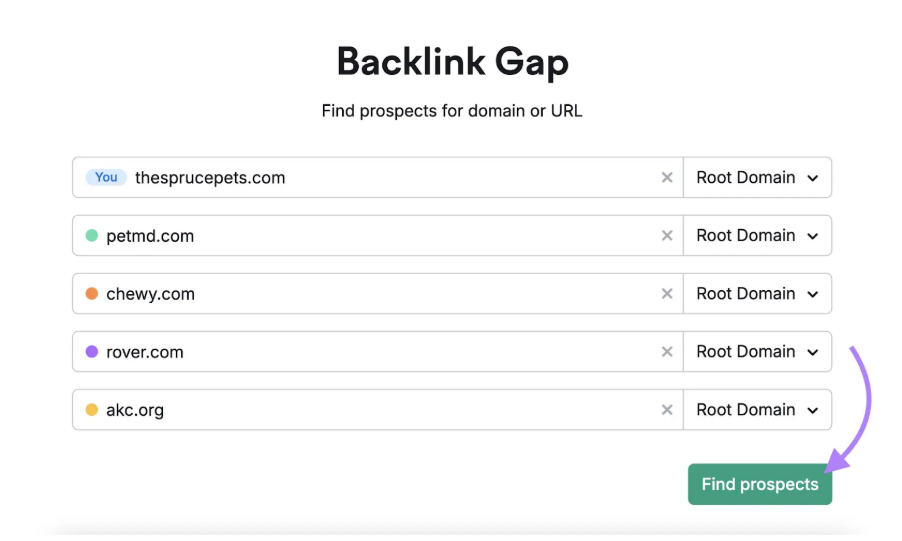
Competitor insights are one of your main link building “inspirations.” So, make sure to regularly check what your competitors are doing. Pay special attention to:
Websites that link to them: Can you get a link from those sites, too?
Content that attracts the most backlinks: Can you write something similar?
Formats they use for link building: Can you try something new, like an interview or an expert roundup?
Messaging for PR: Can you use similar angles to get organic PR?
Of course, you don’t have to copy-paste their strategies. But once you analyze a couple of your rivals, you’ll see general trends that can help you stand out in your niche.
Source: Semrush
But when it comes to scaling link building, you can’t just check it once in a blue moon.
Instead, turn competitor analytics into a system, a habit. For example, one person on your team can be responsible for checking this every Monday (or any other day) and summarizing the insights to your group chat.
If you want, you can even see whether your SEO software allows you to automate the delivery of some of these insights to your Slack or inbox.
7. Outsource part of the work (if needed)
You often hear the misconception that the only benefit you get from link building freelancers and agencies is their fancy SEO client reports.
But in reality, for you, as a small business, this might be exactly the help you need. It can really push your workflow forward or at least keep some backlinks coming, even if your in-house team is overwhelmed with other tasks.
So, consider outsourcing a small part of your work first. For example, you can find a freelancer who specializes in HARO backlinks. And then your team can focus on guest posting and PR placements, for instance.
Overall, you have the following outsourcing options:
A freelancer or a couple of them,
SEO agencies that work on link building or digital PR,
Link building inventories (platforms where you can search for websites that accept guest articles and press releases, and buy them directly without any outreach).
Conclusion
Now, you know everything you need to scale B2B link building successfully. The only thing left to do is take action.
Also, keep in mind that scaling only makes sense once your current processes are stable. Because scaling won’t fix your issues, it will only amplify them. So, unless you have a clear system that works like a clock, don’t expand yet.
But as soon as you have a strong foundation, growing will be easier than you could have ever imagined.